AI helped organize this article. The experience behind it did not come from a prompt. It came from more than 20 years of real mesh-bag production—adjusting yarn, improving machines, changing bag specifications and solving the small factory problems that decide whether a line produces consistently or merely runs.
Short answer: A monofilament mesh bag production line can produce two structurally different product families: date palm bunch cover bags that remain open at both ends and use drawstrings at both openings, and smaller agricultural mesh bags with a sewn bottom and a drawstring top. The investment becomes viable only when equipment configuration, finishing processes, product mix, local operating costs and market access are designed as one system.
A large, recurring market sits behind a simple agricultural bag
Mesh bags are not a fashionable product. They are basic agricultural infrastructure. Fruit, vegetables, firewood and other products that need ventilation, visibility or lightweight protection continue to create demand year after year.
Date-growing regions show the scale of that underlying market. Saudi Arabia produced approximately 1.923 million tonnes of dates in 2024 and had more than 37.6 million palm trees, according to the Saudi General Authority for Statistics. Egypt produces about 1.8 million tonnes annually, representing roughly 19% of global production, according to the FAO. These figures do not equal the number of protection bags used, but they show why date-related agricultural inputs deserve serious local-market study.
For investors in the Middle East, North Africa and other agricultural markets, the opportunity is broader than one bag size or one crop. A properly planned line can serve seasonal date-palm bunch protection while also producing smaller mesh bags for onions, garlic, citrus, vegetables, firewood and other ventilated products. The two products are not simply large and small versions of one bag: their end-finishing structures and field uses are different.
Why local production can create an advantage
Importing finished bags may be the simplest option at the beginning. As demand grows, however, local production can improve control over the variables that matter to buyers:
- Shorter lead times during agricultural seasons
- Faster response to changes in width, length, weight, color and sewing requirements
- Lower dependence on international freight schedules and imported inventory
- The ability to serve smaller or urgent orders
- A local technical and after-sales relationship with growers, packers and distributors
Feedstock access alone does not guarantee profitability. Resin price, electricity, labor, maintenance, financing, sales price and capacity utilization must be calculated locally. The strongest project is not the one with the largest machine list; it is the one whose equipment and product mix match real orders.
One line, more than one product opportunity
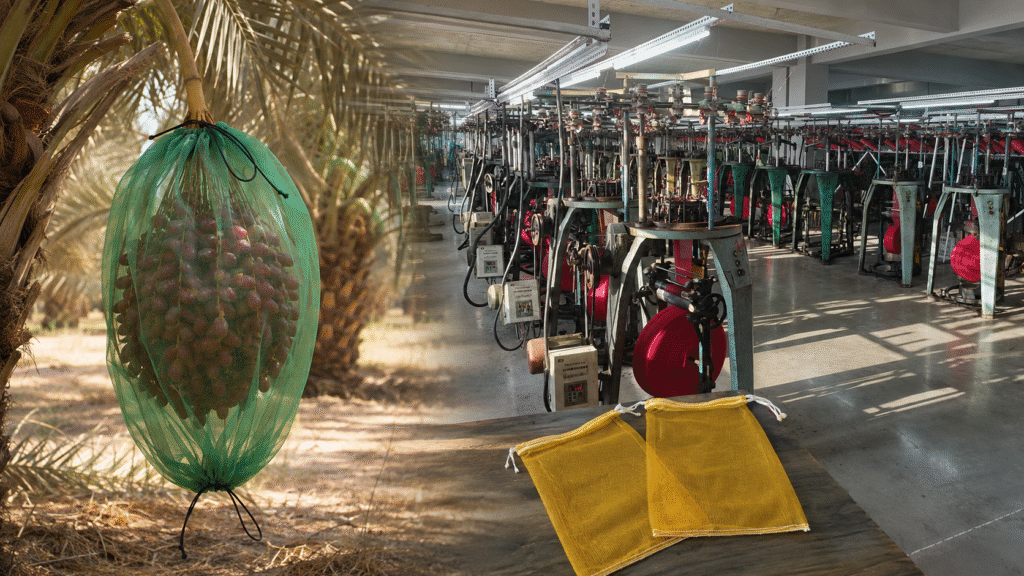
WELLZO’s monofilament mesh bag solution is designed for a practical product range. The date palm bunch cover is a tubular mesh protection bag placed around a bunch while it is still on the tree. Both ends remain open and each end has a drawstring, allowing workers to position and secure the cover conveniently during orchard operations.
Smaller agricultural mesh bags use a different finish: the bottom is sewn closed and the upper opening is fitted with a drawstring for filling and closure. Bag widths can range from approximately 12 cm to 100 cm depending on the final specification and configuration.
This flexibility matters because agricultural demand is seasonal. A factory that can move between suitable product specifications has a better chance of keeping equipment productive and serving more than one customer group. The exact configuration should therefore begin with the buyer’s target products and confirmed market—not with a generic equipment quotation.
The difficult part is not buying machines
A line can be installed and still fail to make competitive bags. The real operating questions appear after delivery: How should yarn parameters change when bag weight changes? How can a lighter bag remain usable and consistent? How should machines be matched to avoid bottlenecks? How can operators reduce repeated trial runs when changing specifications?
These are production questions, not catalogue questions. WELLZO combines the complete equipment line with installation, operator training and know-how developed through long-term factory production. Our goal is to shorten the distance between “the machine is running” and “the factory is producing stable bags that customers will buy.”
Who is best positioned to enter this business?
The fastest adopters are usually existing woven-bag, FIBC, shade-net or plastic-weaving manufacturers. They already understand extrusion, weaving, factory discipline and maintenance. For them, a monofilament mesh bag line can be a product and market expansion.
A new investor can also enter, but the management team and operators must be prepared to learn. We can provide the equipment, installation and training; the local team must still build its own production discipline, sales channel and daily operating capability.
How to evaluate the project before requesting a line
Before discussing a final configuration, a serious investor should be able to answer five questions:
- Which bags will be sold first, and who are the likely buyers?
- What are the local wholesale prices and seasonal demand patterns?
- What are the local costs of resin, labor, electricity, space and maintenance?
- Which bag specifications must the factory produce during its first year?
- Who will lead production, quality control, sales and operator training locally?
Once these answers are clear, WELLZO can recommend a line around the actual product plan, instead of asking the investor to purchase unnecessary capacity or discover missing processes after installation.
What WELLZO provides
- A complete monofilament mesh bag production line supplied as one coordinated project
- Equipment developed with real factory operation in mind
- Installation, commissioning and operator training
- Practical guidance for specification changes, material control and stable lightweight production
- Production planning support based on the customer’s intended products and orders
To protect technical accountability, WELLZO’s process support applies to complete lines supplied by WELLZO. When machines are purchased separately from other sources, we cannot guarantee compatibility or provide technical responsibility for those machines.
The first-mover advantage belongs to the first reliable producer
Agricultural packaging demand already exists. The opportunity is not created by a machine; it is captured by a producer who can make the right bag, at a competitive cost, with stable quality and dependable delivery.
For forward-looking manufacturers and investors in the Middle East, South America, Africa, Central Asia and Russia, local mesh-bag production may become a durable manufacturing business. But timing matters. The earliest capable producer can learn the market, build distributor relationships and improve operations before the field becomes crowded.
Planning a local project? Tell us your target country, bag application, expected specifications and local market price range. WELLZO will help you evaluate whether a complete monofilament mesh bag production line is commercially and technically suitable—before discussing the confidential equipment configuration.
Frequently asked questions
What can a monofilament mesh bag production line make?
It can be configured for date palm bunch cover bags with drawstrings at both open ends, and for smaller agricultural mesh bags with a sewn bottom and drawstring top for produce, firewood and other ventilated products.
Can the same line make both date palm covers and smaller mesh bags?
Yes, but their finishing structures differ. Date palm bunch covers are open at both ends with two drawstrings, while smaller packaging bags normally have a sewn bottom and one drawstring opening. WELLZO plans the production and finishing equipment around the intended product mix.
Is this project only suitable for existing plastic-weaving factories?
Existing manufacturers usually ramp up faster, but new investors can also enter if management and operators are prepared for structured training and sustained production learning.
Does WELLZO provide installation and training?
Yes. Complete-line projects include coordinated equipment supply, installation, commissioning and practical production training. The exact scope is confirmed in the project proposal.
How is the required equipment configuration decided?
It is determined after reviewing target products, local demand, specifications, operating hours, expansion plans and other production constraints. Detailed machine quantities and process settings are provided during project consultation.